
Choose an Urbana Resident Record
A useful resident lookup asks one narrow question at a time. Champaign County property records identify a parcel owner and tax mailing recipient. Election tools test one registered voter against supplied identity details. Court files show a named party's role in a case, while vital indexes place a family event in time. Business and license databases establish an official entity or credential link. Each source proves a different fact, so the record label matters as much as the name.
| Record | What It Confirms | Where | Access Route |
|---|---|---|---|
| Parcel assessment | Owner, situs, mailing line, PIN, sale context | Devnet and CCGISC | Free web search; county office help |
| Voter registration | One person's current registration match | State lookup or ElectionLink | Free staged lookup; Elections fallback |
| Court file | Party role, case number, filings, disposition | Circuit Clerk and eMagnus | Index, file room, or paid request |
| Vital record | Eligible birth, death, marriage, or dissolution facts | IDPH, County Clerk, State Archives | Index, verification, or restricted copy |
| Entity or license | Agent, officer, manager, credential, status | Illinois SOS or IDFPR | Free individual lookup |
| Historical directory | A dated address, school, occupation, or organization clue | UFL and UIUC collections | Scans, catalog, or reading room |
Start with the source closest to the fact already known. An address belongs in the parcel tools. A full name, birth date, and ZIP suit the voter check. A year and case type help the Circuit Clerk. For an older family link, use a dated directory or newspaper before seeking a restricted certificate.
Match Urbana Names to Dates
Same-name errors are the main risk in an Urbana resident lookup. Record the spelling, middle initial, suffix, former surname, approximate age, and one known Urbana street, ZIP, school, business, or relative. Preserve the search date and exact role returned. A tax owner, permit applicant, registered agent, deed grantor, and court party are not interchangeable.
Time is just as important. A historical directory entry should be compared with records from the same period, not with a current parcel owner as if both describe one household. Geography also shifts: an Urbana postal line, legal municipal boundary, tax mailing address, and physical situs can differ.
Keep two address fields. The tax-bill mailing line may lead outside Urbana, while the situs identifies the parcel being assessed.
Check an Urbana Voter Match
The Illinois registration lookup is an identity-based test, not a public list of everyone on a street. Its first stage uses first name, last name, birth date, and five-digit ZIP. A successful match moves to street number and a street name populated from that ZIP. Champaign County ElectionLink supplies the local registration, ballot, and polling route.
| Visible Input | How to Use It |
|---|---|
| First and last name | Use the registered spelling and try a legitimate variant. |
| Birth date | Separates many people who share a name. |
| Five-digit ZIP | Controls the address stage; it does not prove city limits. |
| Street number and name | Tests one address after the identity stage. |
Illinois law redacts sensitive fields and gives special protection to Address Confidentiality Program participants. A failed search may reflect spelling, date, ZIP, move, or protection. Contact Elections for procedure or correction rather than asking staff to disclose private details.
Read Urbana Court Matches Carefully
Urbana cases route through the Champaign County Circuit Clerk in the Sixth Judicial Circuit. The county links to the dynamic eMagnus MultiCourt interface, but its live labels and partial-name rules were not captured. Do not assume a control exists. Treat an online hit as an index lead, then confirm the case number, party role, filing date, and permitted documents.
The View a Court File service explains what may be inspected and copied. Adoption, juvenile, sealed, expunged, impounded, and certain sensitive matters are restricted. Financial, medical, mental-health, Social Security, and identity details may be redacted. The courthouse file room provides paper, digital, and microfilm access, including older material, and staff can help locate public files.
- Case number and court division
- Names and each party's procedural role
- Filing, hearing, and disposition dates
- Public pleadings, orders, and docket entries
- Redactions or access limits noted by the clerk
A written civil or criminal search costs $10 per year searched. General copies cost $2 for the first page, then $0.50 per page through page 20 and $0.25 afterward; certification adds $5. Call 217-384-3725 before paying if a file may be archived or restricted.
The captured public court-file access page shows the official route discussed here.
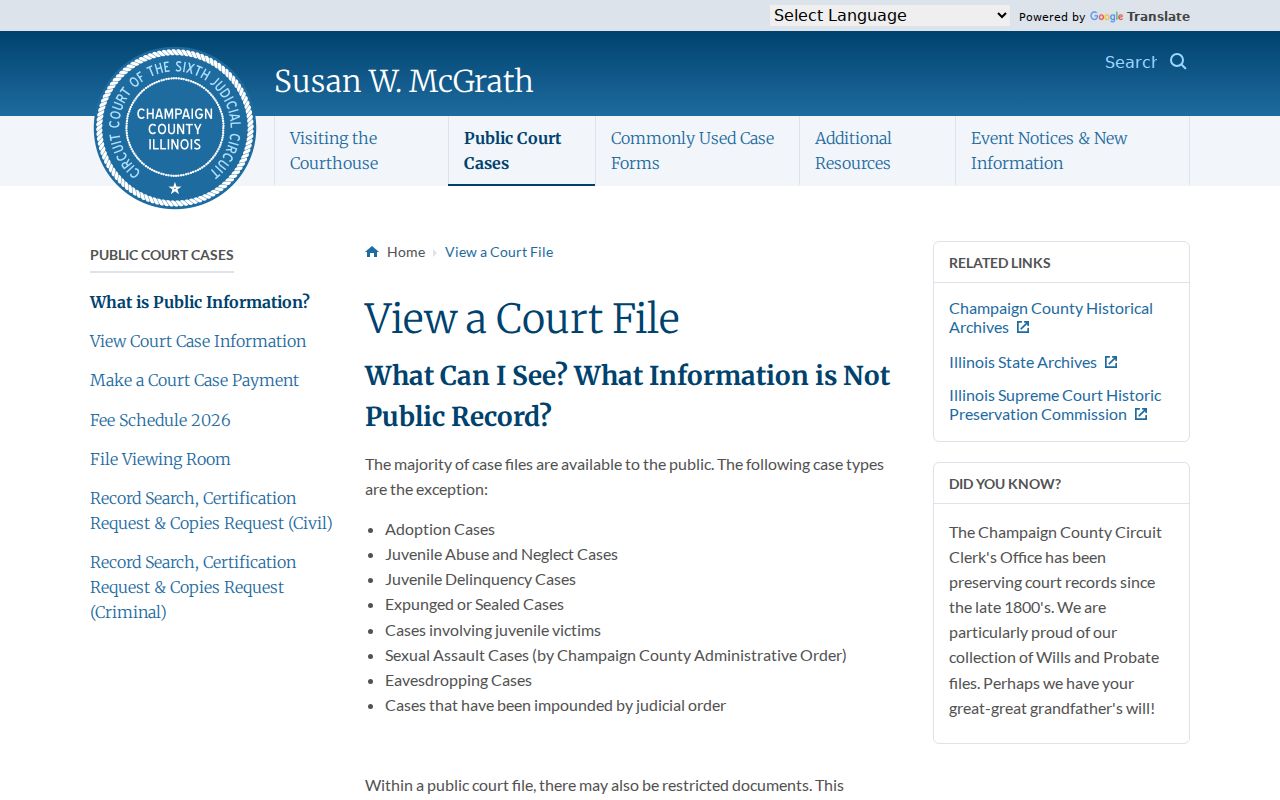
The screen is a starting point for access rules and clerk services, not proof that a same-name result identifies the right Urbana resident.
Verify an Urbana Resident Lookup
Cross-checking keeps a plausible name from becoming a false claim. Use this sequence when a name and Urbana address are both known:
- Search Devnet by address or PIN. Save the owner, situs, mailing line, tax year, and parcel number as separate facts.
- Run the state voter test with the name, birth date, ZIP, and address. Record only the match and lawful registration context shown.
- Check the Circuit Clerk or a relevant historical index. Match date, role, age, relative, or address, not the name alone.
- Ask the custodian for a public file or eligible certified copy only when the index does not answer the question.
- Docket
- The court's dated list of filings, hearings, and orders in one case.
- Index versus image
- An index points to a record. An image shows the document and may require payment or permission.
- Certified copy
- An official copy authenticated by the office that keeps the record.
- Situs address
- The physical location of a parcel, which may differ from the tax mailing address.
Use Urbana Vital Indexes Lawfully
Illinois vital records are not an open people directory. The IDPH Division of Vital Records issues eligible statewide copies and fact verifications. The Champaign County Clerk handles local certified marriage copies and older local material, while the Circuit Clerk issues certified dissolution decrees.
Birth certificates are restricted under 410 ILCS 535/25, with genealogical copies available after 75 years. Death copies require the interest and identification described by IDPH; the official application provides a genealogical route after 20 years. IDPH marriage and dissolution verifications cover 1962 to the current index date. The state marriage index covers 1763 through 1900, and the death-certificate index covers 1916 through 1972.
Online pages and forms are the first channel. Mail is standard for IDPH, with fax, in-person, urgent, or authorized vendor routes available where stated. For pre-registration events, turn to IRAD, Urbana Free Library collections, church registers, newspapers, and cemetery sources.
The Illinois vital records overview illustrates the agency route and its record categories.
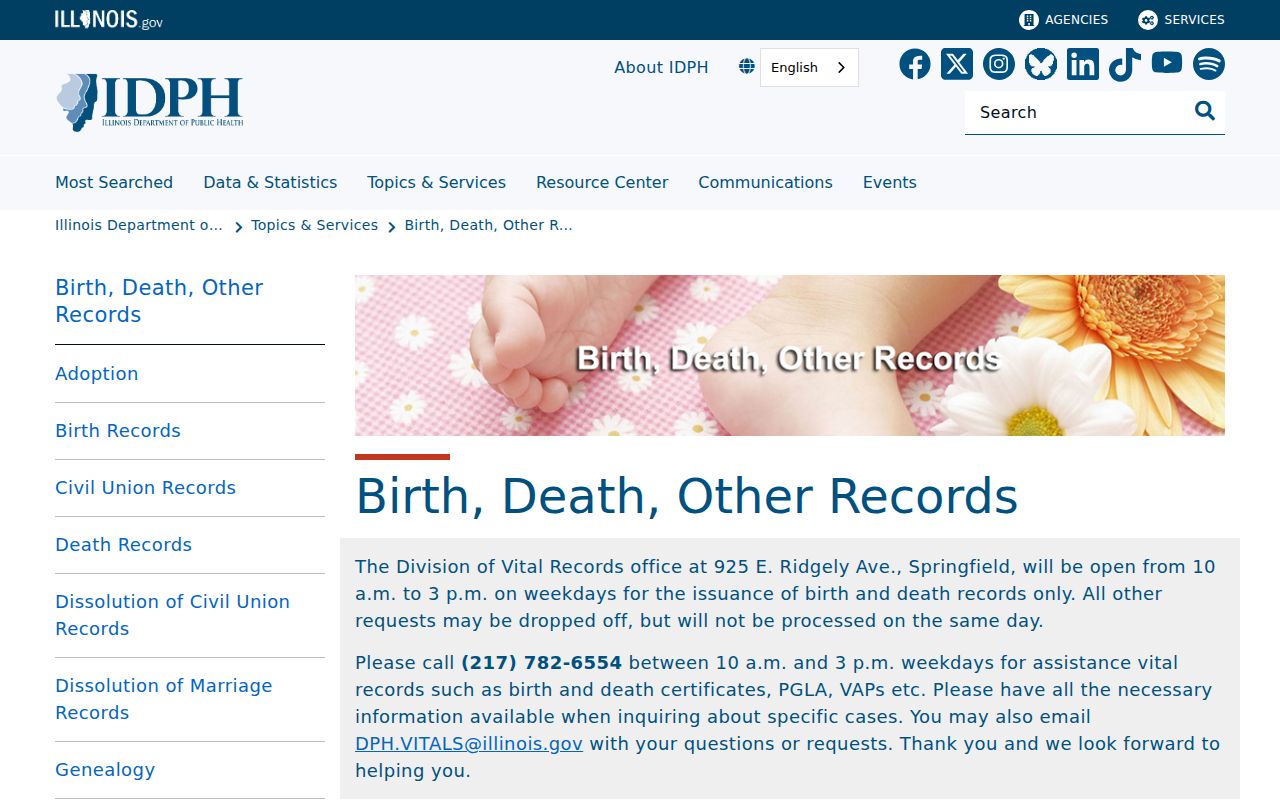
The agency page should lead to the correct form; it is not a public current-name index.
Find Urbana Family Connections
Family and heir research can combine an obituary, dated directory, probate file, and recorded executor or administrator documents. A probate case may show names and relationships, but sealed or restricted material remains closed. A classmate search can use Urbana Free Library and University of Illinois yearbooks, student directories, alumni archives, and dated newspaper notices.
Adoption-relative searches have a safer official path. The Illinois Adoption Registry and Medical Information Exchange lets eligible people exchange identifying or medical information through registration and consent. The DCFS Adoption Records route describes the court-directed Confidential Intermediary Service. Neither program is an open address lookup.
Note: Consent-based programs protect both the person searching and the relative whose current address is not part of an open public record.
Compare Urbana Lookup Sources
Official records are strongest when provenance matters. They identify a custodian, date, record number, legal role, and correction route. Commercial profile tools blend public, marketing, licensed, and user-supplied data. Results can lag after a move, merge two people, or hide details behind a charge.
| Question | Official Record | Commercial Profile Category |
|---|---|---|
| Who issued it? | Named county, state, court, or archive | Compilation method may be unclear |
| Can it be corrected? | Custodian has a defined route | Separate listing-control request may be needed |
| What does it prove? | A dated legal or administrative role | A possible association needing verification |
A commercial suggestion should never replace the Urbana or Illinois office record. Use it, if at all, only as an unverified lead.
Respect Urbana Resident Privacy
The Illinois Attorney General's Address Confidentiality Program gives qualifying survivors a substitute address for new government records and mail forwarding under 750 ILCS 61. It does not promise that every older property document disappears. Court, voter, DMV, vital, juvenile, sealed, and medical records each have separate limits.
If a public record is wrong, contact the office named on it. Assessment handles parcel facts, Elections handles registration, the Circuit Clerk handles docket issues, the Recorder handles indexing questions, IDFPR handles license data, and IDPH handles vital corrections. A correction request is not the same as deleting a valid public record.
Lawful use. An Urbana resident lookup is for lawful personal research. Illinois law forbids stalking, harassment, intimidation, and misuse of protected voter information.