
Start an Urbana Residents Directory Search
An Urbana residents directory search works best when the first record matches the clue already in hand. A street address points to the Champaign County parcel roll and CCGISC map. A full name, birth date, and ZIP can support a personal registration check. A date from decades ago belongs in the city directories, newspapers, maps, or archives. Each source identifies a role, not an entire household.
Keep the original spelling, date, and place heading from every result. An owner, voter, deed party, permit applicant, student, or court party may have a valid Urbana connection, but those labels are not interchangeable. The Urbana residents directory becomes reliable only when two independent, dated records agree.
- Normalize the name or address, and note the likely year.
- Use Devnet or CCGISC to identify a parcel and PIN when an address is known.
- Use the Illinois registration lookup only for a staged, one-person match.
- Check deeds, court indexes, directories, or vital indexes for a second date and role.
- Ask the custodian, library, or archives when the web index ends.
The Offices Behind Urbana Resident Rolls
Urbana is the Champaign County seat, so several key custodians are close together. The Recorder preserves deeds and related instruments. The Assessment Office and township assessor maintain parcel and mailing information. The County Clerk administers elections and vital records, while the Circuit Clerk controls court files. City records remain with Urbana. Confirm a counter location before visiting because county pages use 102 E. Main Street while Recorder materials also cite 1776 E. Washington Street.
Champaign County Recorder
1776 E. Washington Street
Urbana, IL 61802
217-384-3774
Champaign County Assessment
102 E. Main Street
Urbana, IL 61801
217-384-3760
Urbana Parcel Clues Begin With Devnet
The Property Tax and Assessment Inquiry is the practical first check for an Urbana address. Its ordinary parcel form is keyed to location and PIN, not owner name. That distinction matters. Mobile Home Search has an Owner Name field, but the regular real-estate search inspected during research did not.
| Portal field | Use in a search | Caution |
|---|---|---|
| House Number | Narrow an exact site | May be left blank for a street sweep |
| Street Name and Type | Find parcels along one road | Use supplied street components |
| City | Limit the location form | Postal place is not proof of city limits |
| Parcel Number | Return to one legal tax parcel | Keep all digits accurately |
| Sale, class, district, tax year | Refine an advanced parcel search | Availability varies by record |
Four terms to keep straight. A roll lists records; an index points to a record; a parcel is a mapped tax unit; a criss-cross directory runs from address to name.
Urbana Situs and Mailing Addresses Tell Different Stories
A parcel card may carry both the physical situs address and the address where a tax bill goes. The situs line locates the land. The mailing line identifies the recipient selected for tax correspondence and can be elsewhere. Neither field alone proves who sleeps at the property. This is one of the most useful Urbana search distinctions because it prevents a mailed bill from being mistaken for a household list.
Save the PIN, legal description, current owner label, both address lines, latest assessment year, and sale history together. Then move from the tax roll to the deed index if ownership history matters. A renter or other household member may never appear on either record.
Check an Urbana Voter Record in Two Stages
The Illinois Registration Lookup is an identity check, not a browsable Urbana resident roll. The first stage asks for first name, last name, birth date, and a five-digit ZIP. The next asks for street number and a street name loaded from that ZIP. A failed result means only that the submitted combination produced no match.
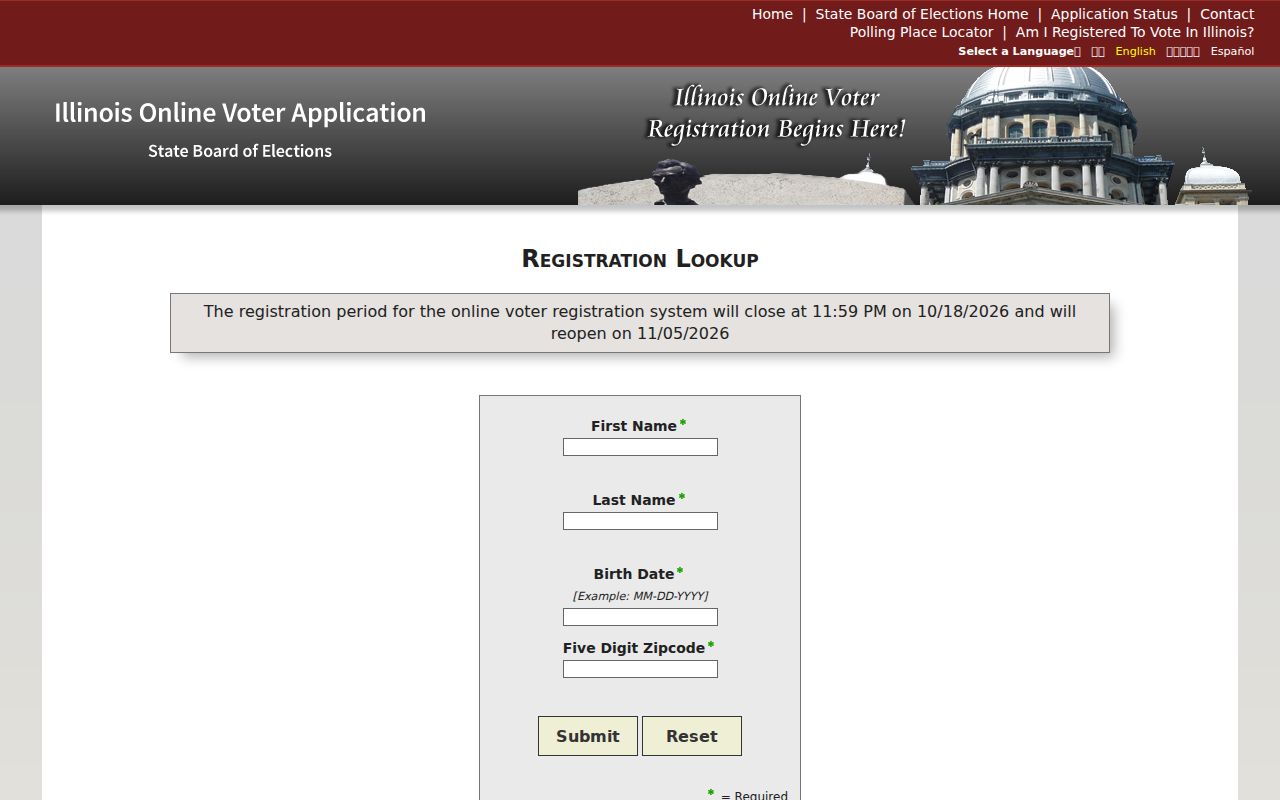
The captured state form shows why an Urbana search must begin with known identity details rather than a broad street list.
| Stage | Required fields | What follows |
|---|---|---|
| Identity | First name, last name, birth date, five-digit ZIP | Submit advances to address |
| Address | Street number and populated street-name choice | Submit runs the match |
| County fallback | House number, street, city, state, ZIP, county; unit optional | ElectionLink returns polling-place context or a no-record notice |
Illinois law redacts sensitive registration fields, and Address Confidentiality Program participants receive special protection. No public result reveals a ballot choice. For a polling location, use Champaign County ElectionLink or call the County Clerk rather than trying to infer an answer from a map.
Compare Current Urbana Directory Sources
No current source lists all Urbana residents. Each official index covers a defined public role. Start with the row that answers the question, then confirm the name and date elsewhere. The dedicated Urbana resident lookup explains how to test one person without merging unlike records.
| Current source | Connection shown | Custodian | Route |
|---|---|---|---|
| Assessment roll | Parcel owner, mailing recipient, situs, sale and tax context | County Assessment Office | Free Devnet search; counter questions |
| Registration lookup | One voter's registration match and district context | State Board and County Clerk | Staged lookup; protected fields withheld |
| Recorded deed index | Grantor or grantee lead tied to a PIN | County Recorder | Free index; paid image or counter |
| Permit dataset | Applicant and dated work tied to address or parcel | Urbana Community Development | Open Data since 1999; CitizenServe |
| Court index or file | Named party and case role | Circuit Clerk | eMagnus, file room, forms, copies |
Official rolls disclose their source and keeper. Commercial profile tools often merge old addresses, unrelated names, and recycled phone data without clear provenance. They may charge for a result that is less precise than the free public index. Use the official record first, note its role and date, and pay only when an actual image or certified copy is needed.
Follow an Urbana PIN Into Recorded Deeds
The CCGISC Recorded Deeds page accepts a PIN plus result-order controls. A visible result can supply a grantor, grantee, instrument date, and document clue. The page warns that more parties may appear on the deed than the summary shows, so an index name is only a lead.
Full instruments route through Fidlar Tapestry, which may require payment, or through the Recorder counter. Ask the Recorder at 217-384-3774 about old deed books, certified copies, or an image missing from the web result. No official source inspected for this build gave an exact online start year. IRAD lists Champaign County deeds from 1833 to 1902 and deed indexes from 1833 to 1927, but those series spans do not mean every page is digitized.
Urbana Court Files Need a Party-Role Check
The Champaign County Circuit Clerk links to the dynamic eMagnus MultiCourt search. When the interface does not expose an older or complete file, the courthouse file-viewing room at 101 E. Main Street supplies paper, digital, and microfilm access subject to record restrictions. Civil and criminal search-request forms also provide mail or staff-search routes.
A docket can show a case number, filing dates, parties, attorneys, event entries, dispositions, and document references. It does not show that every named party lived in Urbana, and restricted or sealed material remains unavailable. Confirm the party role, case type, date, and another identifying fact before connecting a same-name result to an Urbana residents directory entry.
Use Urbana FOIA When No Index Exists
Municipal permit, inspection, code, meeting, correspondence, or incident records may require the Urbana FOIA form. It asks for requester contact information, delivery choice, commercial-use status, and a focused description of the record. The city states a normal five-business-day response framework, subject to an extension and exemptions, and warns that submissions are publicly accessible.
The Urbana City Clerk page shows the municipal custodian and its records routes.
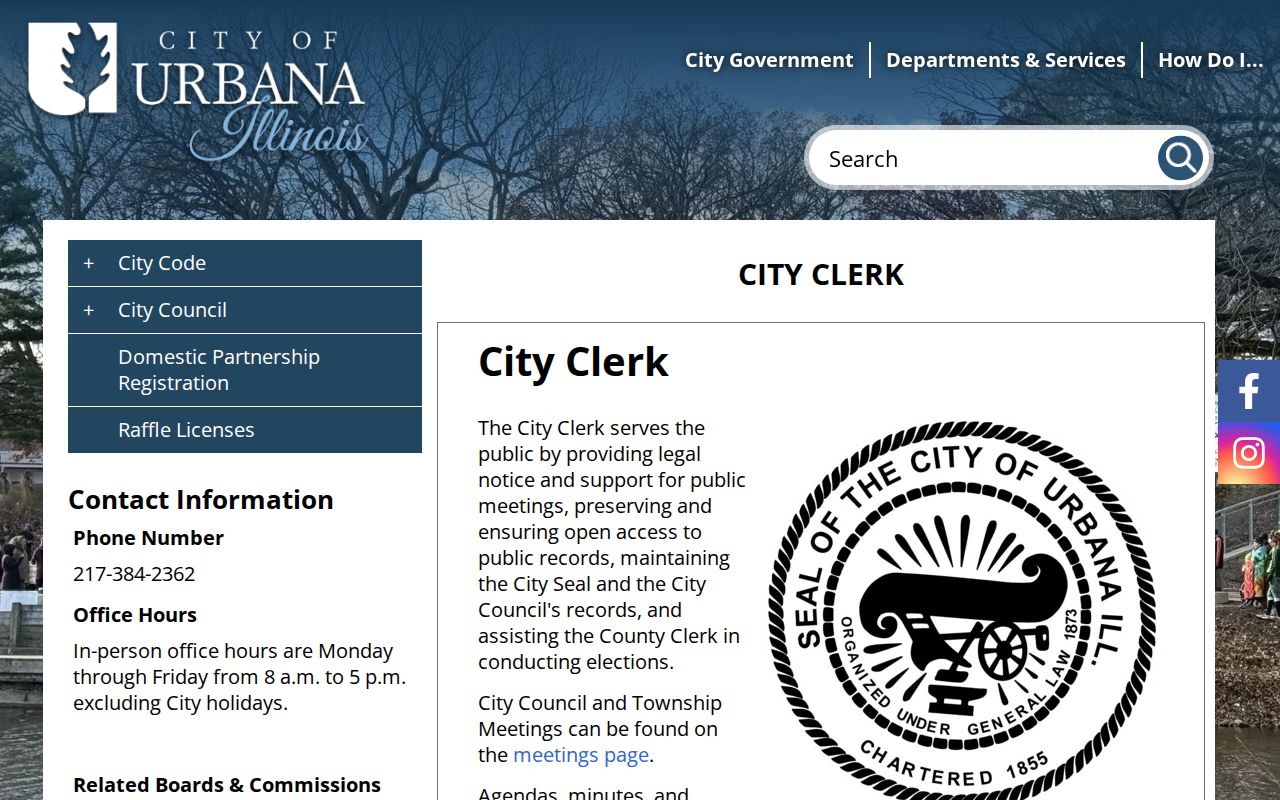
This city source is the correct bridge for council records and municipal FOIA questions, not a county deed or court-file request.
Ross McNeil is the listed Urbana FOIA contact at 400 South Vine Street, 217-384-6276. County records go to the relevant county department under the Illinois Freedom of Information Act, 5 ILCS 140. Court files go directly to the Circuit Clerk rather than through FOIA. For both city and county requests, the first 50 pages of ordinary black-and-white copies are free under the stated local rules, with permitted charges after that point.
Urbana Vital Records Have Firm Access Gates
Birth and death certificates are not open resident rolls. Under the Illinois Vital Records Act, 410 ILCS 535/25, certified birth copies go to the adult person named, a parent shown, or a qualified legal representative. Genealogical birth copies open at 75 years. A death copy requires the interest stated by the agency, while the official application provides a genealogical route for deaths over 20 years.
The Champaign County Clerk issues eligible county-held certified copies and marriage records. The Illinois Department of Public Health handles statewide copies and marriage or dissolution verifications from 1962 through the current index date. Certified dissolution decrees come from the Circuit Clerk. Historical state marriage and death indexes can give a research lead, but an index is not the certificate image.
When an Urbana Web Search Ends
Online access is only the top layer. Call the Recorder for an old deed index. Visit the Circuit Clerk file room for paper, digital, or microfilm court material. Ask Urbana Free Library archives staff to retrieve a collection with 48 hours of lead time. Use the Illinois State Archives and IRAD catalog for named Champaign County record series. Narrow city or county FOIA requests to the custodian and date range.
The Urbana Free Library archives are on the second floor at 210 W. Green Street. Staff can be reached at 217-367-4025 or archives@urbanafree.org, and appointments are preferred. Its copy route costs $10 per 10 items plus listed copy, scan, or shipping charges. Those are research copies, not certified government records.
Read Historical Urbana Resident Directories
Urbana Free Library describes Champaign County directory coverage from 1870 to the present, with uneven city, telephone, and criss-cross runs. Digitized city directories are identified for 1878 through 1950, while later paper and telephone volumes need a catalog or staff check. A conventional volume runs from name to address; a criss-cross volume reverses that path. Entries may use initials, occupation or business labels, spouse references, “r” or “rs” for residence, “bds” for boards, and corner descriptions.
Use adjacent years because a missing name can reflect spelling, abbreviation, a move, or a gap in the run. Urbana-area newspapers from 1822 through 1931 are available through the documented local route, with later material on microfilm or under other access limits. Sanborn sheets for Urbana from 1887 through 1923 and 1929 can explain a building footprint without naming every occupant.
Market Street Can Mean Broadway in Urbana
Old Urbana names do not always align with a modern search box. The original 1833 plat used names including Water, Main, Elm, Green, Vine, Walnut, and Market. Market later became Broadway. A directory entry that gives a corner rather than a number may be more useful than a forced modern address.
Pair the street guide in the volume with an old map and the library's finding aids. Those aids can be indexed by street, town, direction, and house number, such as a west Green Street address. No official source located for this project established one verified citywide renumbering year, so a careful search preserves the wording printed in the source instead of inventing a conversion date.
Keep an Urbana Residents Directory Search Lawful
Use public records for family history, estate and heir research, reconnecting, property history, civic questions, or checking a suspicious claim. Never use a name, map, or address trail to watch, threaten, stalk, harass, or harm someone. Illinois protects qualifying survivors through the Address Confidentiality Program, and protected voter information, sealed court material, vital certificates, motor-vehicle data, utility records, and private household details remain outside an ordinary search.
A missing result is not a verdict. It may reflect a protected address, restricted record, old spelling, incomplete web index, different role, or stale source.
Verify any material fact with the office that keeps the record. Save the access date and exact role shown. If a record appears wrong, ask that custodian about its correction process rather than spreading the claim. That discipline turns the Urbana residents directory from a pile of possible names into a clear, sourced research path.