
Urbana Previous Resident Sources
Each period in an Urbana address history has a different best source. Start with the newest reliable identity of the parcel and move toward older records. Keep the source date beside every name. A deed records a transfer, a directory reports a listed address, and a census describes a household on its enumeration date. Those facts can support one another without being interchangeable.
| Source | Years It Covers | Where Held | What It Shows |
|---|---|---|---|
| Recorded deeds / IRAD | Online cutoff unstated; books 1833-1902, index 1833-1927 | Recorder, CCGISC, Tapestry, IRAD | Transfers, legal descriptions, parties |
| City and county directories | 1870-present, uneven; Johnson volumes 1878-1940 | UFL, UIUC, Genealogical Society | Names, work, residence, corner, boarder marks |
| Telephone / reverse directories | Telephone series noted 1920-current; reverse run incomplete | UFL local-history shelves | Subscribers and address-to-name clues |
| Federal census | Released under the 72-year rule | National Archives and library databases | Household, relationship, birthplace, work |
| Sanborn and historic maps | Urbana 1887-1923 and 1929; other maps 1858-1869 | UFL, UIUC, digital maps | Footprint, use, lot and street context |
| Urbana permits | Open Data since 1999 | Illinois Open Data / City | Dated work, parcel, applicant, type, status |
| Urbana newspapers | 1822-1931 online; later microfilm | County Library / UFL | Moves, obituaries, marriages, property notices |
For recent previous residents, use the parcel card, deeds, and permits first. For the twentieth century, pair directories with census and maps. The earliest chain often needs deed books, historic plats, newspapers, and archive staff. No online portal replaces that era-by-era choice.
Fix the Urbana Parcel First
Before looking for Urbana previous residents, establish the current parcel in Devnet or CCGISC Maps. Save the exact street wording, house number, ZIP, PIN, subdivision, lot or block, map point, current tax year, physical situs address, and tax-mailing address. The PIN and legal lot stay useful when a street label or postal line changes.
The mailing line deserves its own column. It is the address used for tax correspondence and can point outside Urbana. It does not prove that the named owner lived at the parcel. Likewise, an owner-occupied assessment flag describes an exemption or classification, not each person in the household.
Note: A modern street address can match the wrong historic parcel after a subdivision, so preserve the legal description before going back.
Trace Champaign County Deeds Back
A chain of title is the sequence of recorded transfers for the same property. Start from the latest known owner and verify every link by legal description. The Recorder's public PIN results can supply free dates and party clues. Full images may require paid Tapestry access, an office request, or older index books.
- Copy the current PIN, owner, legal description, subdivision, and sale date from the assessment card.
- Enter the PIN in CCGISC Recorded Deeds. Note the instrument date, grantor, grantee, and document clue.
- Open or request the deed. Confirm the legal description and all parties because the index may display only one grantor or grantee.
- Treat the seller as the prior owner, then locate the deed by which that party received the property. Repeat with the same legal description.
- When the online trail stops, move to the Recorder counter, deed books, indexes, microfilm, and IRAD series. Do not assume an unstated portal cutoff.
- Grantor / grantee
- The grantor transfers an interest; the grantee receives it.
- Chain of title
- The ordered trail of recorded transfers for one property.
- Legal description
- Lot, block, subdivision, or survey wording that identifies land more reliably than an old street number.
- Criss-cross directory
- A directory arranged by street address or phone, useful for finding a listed occupant from a place.
The online index is a lead, not the deed itself. Save book, page, or document number when visible and keep the access location in the chain note.
Urbana Deed Access Choices
Free parcel maps and deed-index leads answer where to look. They do not replace a complete instrument or certified copy. Choose the access channel according to the claim that needs support.
| Route | Best use | Limit |
|---|---|---|
| Devnet / CCGISC | Current PIN, owner and map placement | Not a full ownership history |
| Recorded Deeds | Free instrument and party leads | Incomplete-index warning; cutoff unstated |
| Tapestry | Paid document images | Vendor charges and image availability vary |
| Recorder counter | Office help, older indexes, official copies | Requires a focused parcel or party request |
| IRAD | Deed books and indexes from early county series | Series dates do not promise every image online |
For an estate or heir question, use the deed image and any related probate instrument rather than relying on a portal summary. A later mailing address may help distinguish two people with the same name, but it is not proof of residence at the former parcel.
Urbana Archives by Street Address
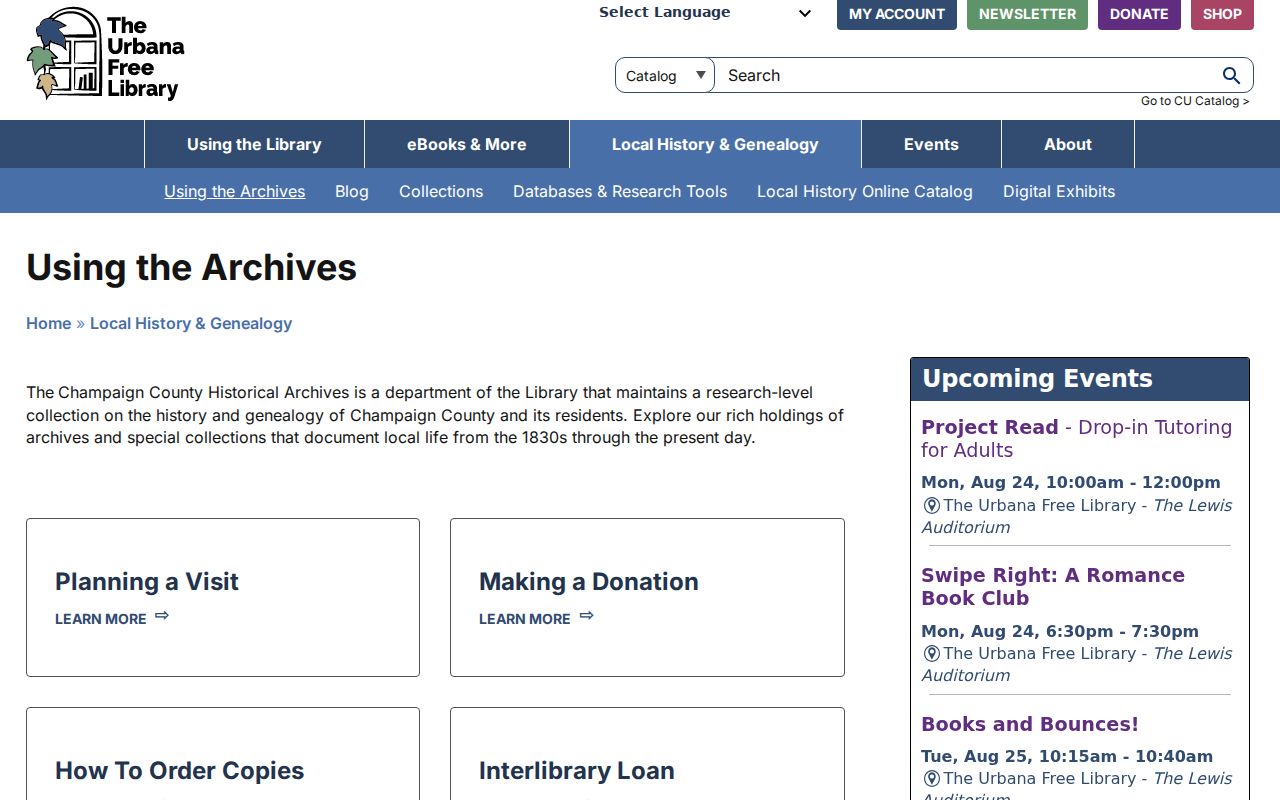
The Urbana Free Library offers a practical previous residents route through its finding aids, maps, appointment process, and copy service. Search a street name, direction, and house number, then preserve the exact collection, box, and folder citation. Plan for retrieval at least 48 hours ahead when an archive visit or staff pull is needed.
Review the library's archive-use instructions before the captured page below. The access guidance matters because a catalog hit may identify a physical folder without digitizing its contents.
A 2025 finding aid for the City of Champaign Local Improvement Collection covers 1910-1930 street, sewer, sidewalk, and lighting work. It can provide comparative county urban-street context, but label it Champaign rather than treating it as an Urbana municipal file.
Map Urbana Before Naming Residents
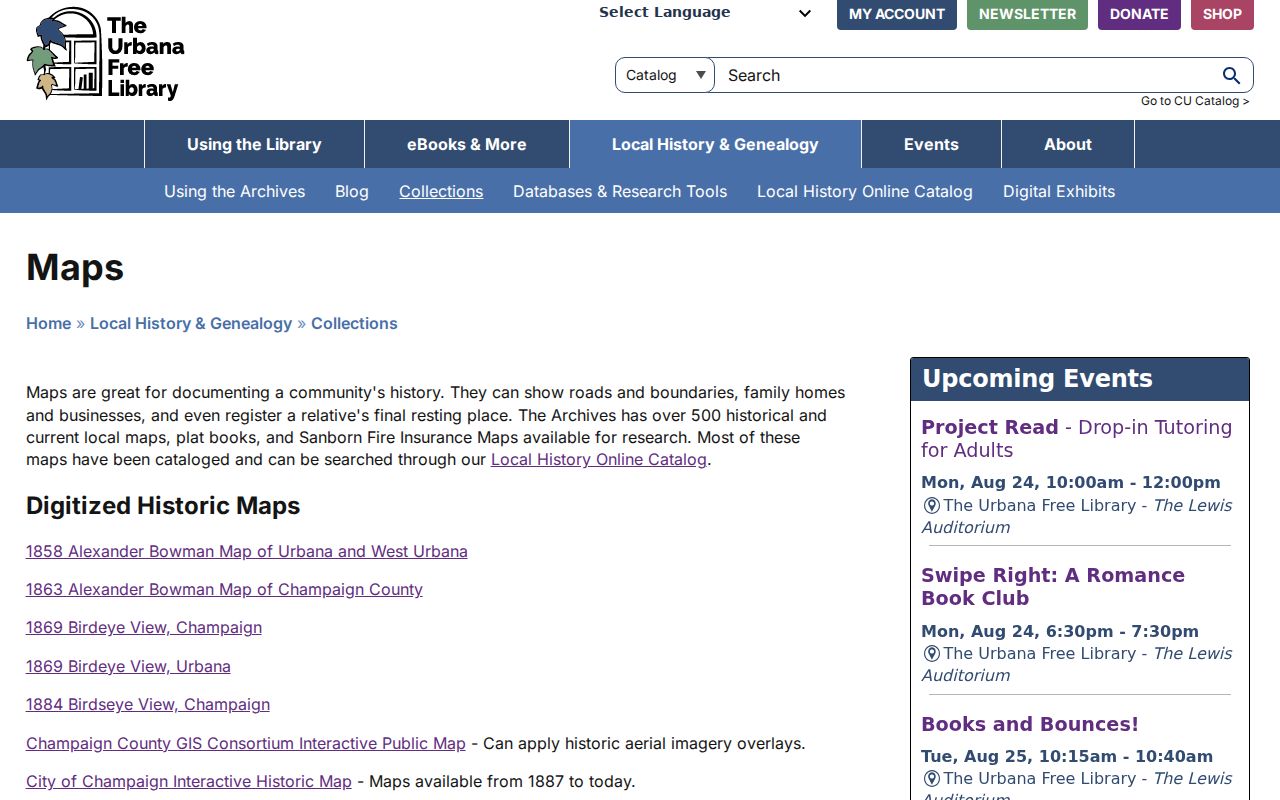
A Sanborn fire-insurance sheet can show whether a building footprint, use, or adjacent lot existed during a given period. Urbana coverage includes sheets from 1887 through 1923 and a 1929 layer. Other local maps date to 1858, 1863, and 1869. Maps do not name every occupant, but they keep the address trail tied to the right structure.
Open the Urbana Free Library map collection that appears in the image below. Compare the building, lot, and street wording before assigning a directory entry to the modern parcel.
Bridge Market to Broadway
Urbana's original 1833 plat named Water, Main, Elm, Green, Vine, Walnut, Market, and several alleys. Market later became Broadway. An old entry may also identify a corner rather than a house number. Search the wording printed in the source first, then use the plat and a period map to connect it to the modern street.
No verified citywide renumbering year or complete renaming schedule was found. That gap is important. Do not force old and new numbers together because they look close. A lot, block, legal description, adjoining owner, and mapped footprint form a stronger match.
Note: In a historical directory, the original corner description can be more reliable than a modernized address added without a source.
Urbana Permits Mark Later Change
The Urbana Open Data permit set contains records since 1999. A row may provide issue date, address, parcel, permit type, improvement, applicant, fee, mapped address, and status. It can date a building change between two resident records. The applicant's role may be contractor, owner, or organization, so it should never be silently turned into an occupant.
For earlier work, local guidance notes municipal plans and permits dating to the 1950s, but exact surviving box and file coverage needs confirmation from UFL, CCHA, or the City. Ask by address, PIN, date range, and work type. A focused Urbana FOIA request is the fallback for a specific nonexempt file.
Pair Urbana Directories and Census
Directories fill the long gaps between released federal census schedules when tracing previous residents. Reverse volumes work from an address to a listed name, while conventional volumes begin with a surname. The federal census adds relationships, ages, birthplaces, and occupations for a household on its census date.
- Choose the directory year closest to a deed transfer or known event and copy the entry exactly, including abbreviations and corner wording.
- Check the street guide or reverse section for the same address. Search adjacent years because editions are uneven and a move may fall between them.
- Find the nearest released census. Match names, ages, relationships, work, and neighbors rather than relying on spelling alone.
- Return to a later directory to test whether the household stayed, moved, or changed its listed head.
- Add a newspaper, obituary, probate file, or deed only when it supports the same person and time.
The historical volumes themselves, including their publishers and abbreviations, are covered on the Urbana city directory page.
Read an 1878 Urbana Directory
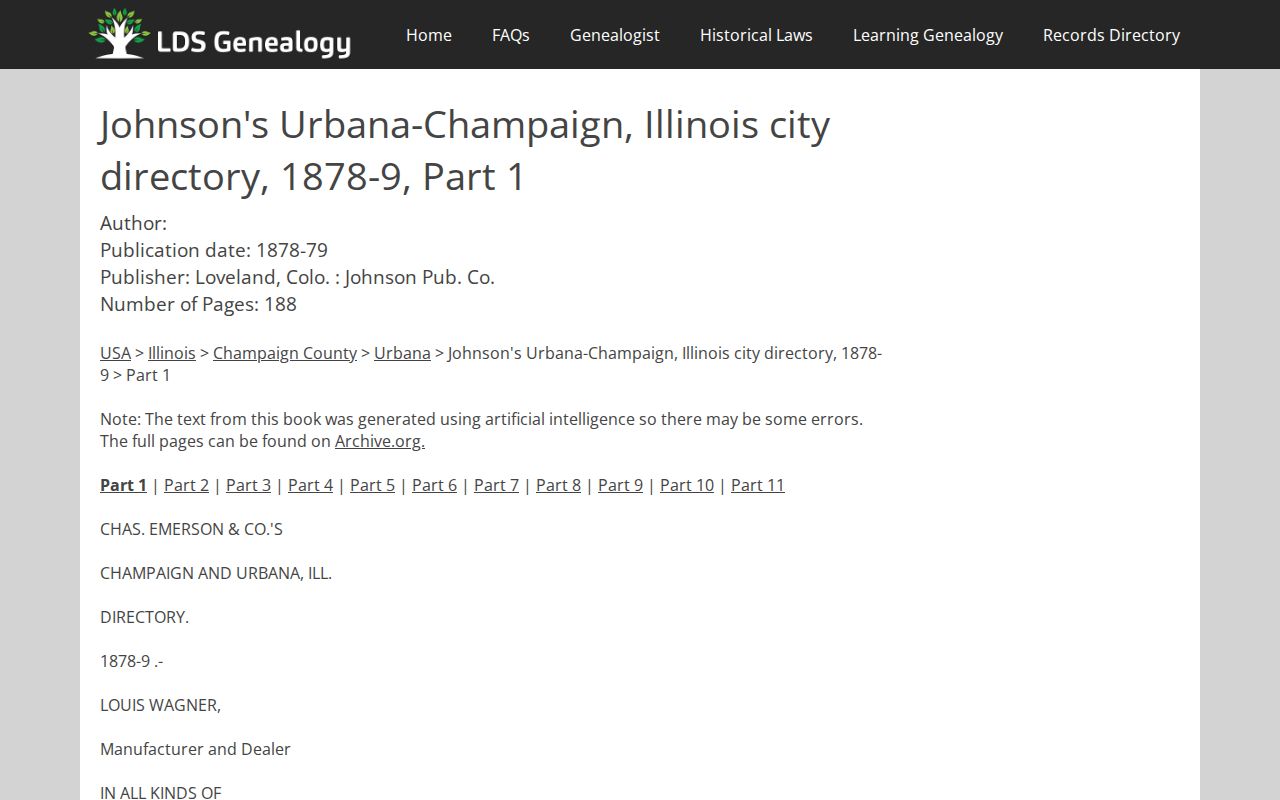
One surviving online entry point is the 1878-79 Urbana-Champaign directory transcription. A listing may record a name, trade or business, residence, a corner, and marks such as “bds” for boards. That language can place a listed person without proving ownership.
View the 1878-79 directory transcription shown in the captured image. Search both surname and street wording, then confirm the result against a scan, map, or another dated record.
Close Urbana Previous Resident Trails
Ownership is only half the address story. A listed occupant may never appear in the deed chain, while a tax owner may never have lived there. Treat directories and census schedules as the household layer, deeds as the property layer, and permits or maps as the building layer. Names become far more reliable when two layers agree on place and time.
When a trail reaches a deceased owner or resident, use Urbana-area newspapers, obituaries, recorded executor instruments, and Champaign County probate files. These can explain an estate transfer or connect heirs. An obituary is not a certified record and may omit addresses. Current death certificates remain restricted under Illinois law.
A business or institution in the chain calls for a different check. Secretary of State records, professional-license records, advertisements, and organization pages can separate a company from a person with a similar name. Preserve the role stated by each source.
Lawful use. Research Urbana previous residents for family history, estate work, or property curiosity. Never use a historical trail to harass, stalk, or expose a living person.