
Urbana Directory Runs by Year
The Urbana Free Library directory collection describes Champaign County holdings from 1870 to the present. The shelf combines city, telephone, county, and Criss-Cross volumes rather than one complete annual title. A local bibliography identifies runs from 1878-79, 1883-84, 1893, roughly every two years from 1898 through 1920, and further volumes through 1994. Telephone books begin in 1920 in that finding aid. Catalog and staff checks remain important because a listed span does not mean each year is online or continuously held.
| Collection | Years | Where Held | Access |
|---|---|---|---|
| City and county directories | 1870-present, uneven | Urbana Free Library and local partners | Catalog, scans, or archive appointment |
| Johnson's Urbana-Champaign series | Listed volumes, 1878-79 through 1940 | UIUC digital library and UFL | Free scans for listed years; shelf checks for gaps |
| Telephone directories | 1920-current in the ISGS guide | UFL local history | Shelf, microfilm, or staff retrieval |
| Criss-Cross directories | Local runs; full year list not published | UFL directory collection | Address-to-name research, chiefly in person |
| Urbana newspapers | 1822-1931 online; later years restricted by format | County and UFL collections | Online, microfilm, or library computer |
The Champaign County Genealogical Society lists specific county and Johnson volumes, including clusters that skip years. Those breaks matter. A missing person may reflect a missing book, a county-only edition, an unlisted household, or a move. It is not proof that the person left Urbana. Verify the title, year, publisher, and place heading on each image before comparing entries.
Urbana Directories Open Online
The UIUC digitized Johnson series provides scans for selected volumes, including 1878-79, 1883-84, 1890, 1893, 1895-96, 1902-03, 1908, 1912, 1919-20, 1922, 1925, 1927, and 1935 through 1940. The scanned title page and contents are part of the evidence. Some books include other Champaign County communities, so always read the place heading before treating a result as an Urbana residence.
The library's Books and Journals collection also identifies city directories from 1878 through 1950 online within a much larger local-history collection. Online access is free for the identified scans. When OCR misses a name, browse the alphabetical pages, try initials, and inspect the street or business section.
The UIUC series is visible in the captured collection view below.
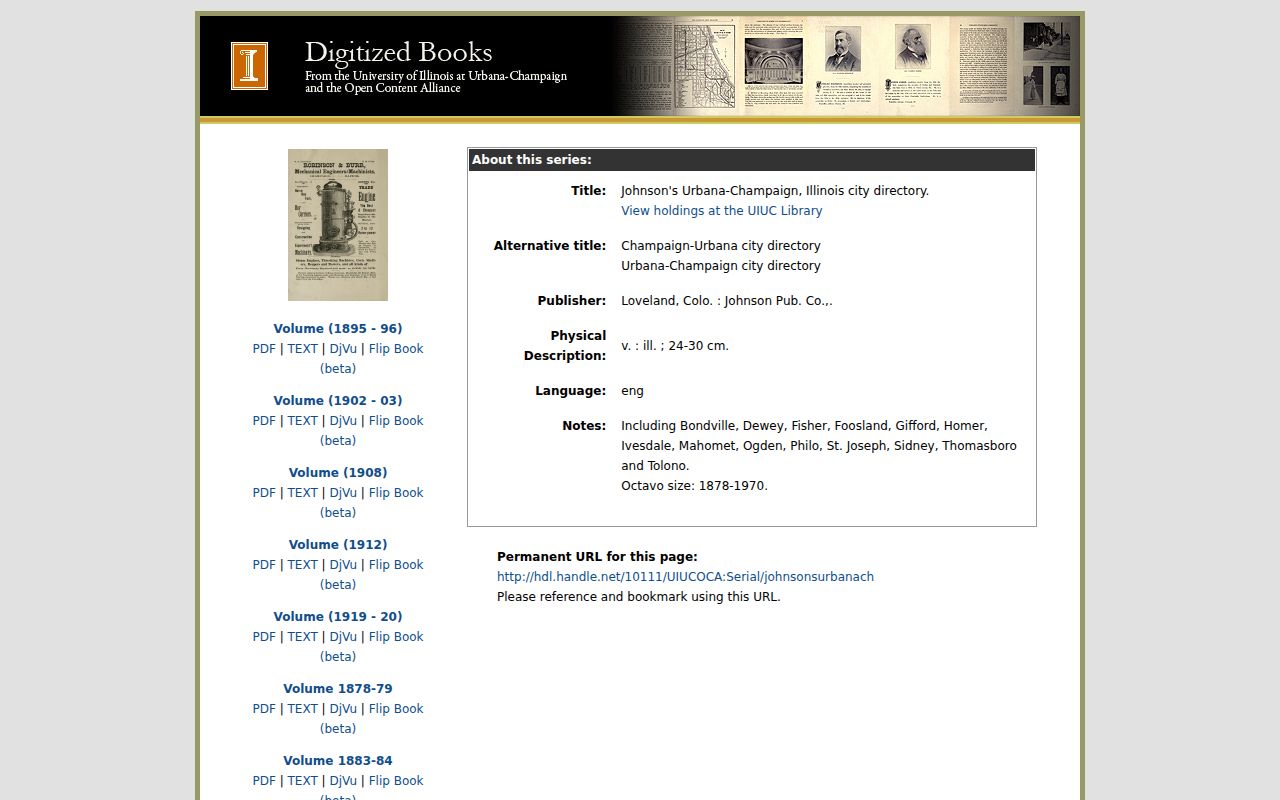
The volume list lets a researcher choose a real publication year before searching names, streets, or institutions.
Urbana City Directory Publishers
Urbana's directory record changes hands and format. The first known book is J. S. Lathrop's 1870-71 directory. Later identified publishers include Emerson and Watson in 1878-79, McKenzie in 1885, Glass in 1898-99, Flanigan-Pearson in 1946, R. L. Polk in 1969-70 and 1997, Johnson in the 1970s and 1982, Premier in 1993-94, and GDT in 2001. These are separate series, not one uninterrupted database.
| 1870-71 | First known city directory, published by J. S. Lathrop |
|---|---|
| 1878-99 | Emerson/Watson, McKenzie, and Glass titles appear in identified years |
| 1946-82 | Flanigan-Pearson, Polk, and Johnson editions mark later formats |
| 1993-2001 | Premier, Polk, and GDT are named in the local survey |
Publisher shifts can change abbreviations, sections, geographic scope, and page order. Photograph the key and title page along with the resident entry. The Genealogical Society directory inventory is especially useful for checking which editions exist locally.
Decode an Urbana Directory Entry
The 1878-79 transcription shows how compact an early entry can be. A line may give an alphabetized name, a trade or business, a residence marked with r or rs, and a street or corner description. bds means the person boarded at the stated place. The inspected sample did not prove that every year consistently gives a spouse or owner mark, so those fields should never be assumed.
| Name | Surname first, followed by the given name or initials |
|---|---|
| Work | Trade, business, civic role, proprietor, or railroad connection |
| Residence | r or rs, then a street, direction, number, or corner |
| Boarding place | bds, sometimes at an address apart from the business |
| Place clues | Cross streets and directions that must be checked on the volume's street guide |
- Criss-cross directory
- A later directory arranged by street and house number, allowing an address-to-name search.
- Householder index
- A name or address list focused on the people associated with households in that edition.
- Abbreviation key
- The publisher's list explaining short forms. Read it before decoding a line.
One early example places a business on Market Street. Market is now Broadway, so copying only today's street name would lose the record's wording. Another gives a corner rather than a house number. Preserve the printed line first, then translate it with maps.
Search Urbana Streets Two Ways
An alphabetical name search is only half the work. A resident may be listed under initials, an abbreviated given name, a firm, or an institution. Search the street guide as well. Later Criss-Cross volumes reverse the order and place addresses first, which helps when a surname is unknown. Exact reverse-directory years are not published, so call the archive before planning a visit around one date.
Historic Urbana adds a useful quirk. The original 1833 plat named Market Street, now Broadway, and preserved named alleys. An entry that says “corner of” two streets may align better with an old plat than a modern house number. The library's original streets and alleys article provides the local bridge. No verified citywide renumbering year was found, so do not force every old address into a single conversion rule.
Note: Record the exact printed address before translating it to a modern street, parcel, or map point.
Urbana Archives Beyond the Screen
The Champaign County Historical Archives at UFL is the main fallback when a volume is absent online. The archive is on the second floor at 210 W. Green Street. Staff recommend an appointment and 48 hours for retrieval. Researchers may call 217-367-4025 or email archives@urbanafree.org. This route reaches directories, maps, clippings, photographs, finding aids, and county-history material.
Remote requests are also possible through the copy service. The listed charge is $10 per 10 items, plus $0.50 per page for copies, scans, and shipping. Provide an exact citation or catalog title. These copies support research, but they are not certified civil records.
The library's local-history collection can be previewed through the captured source below.
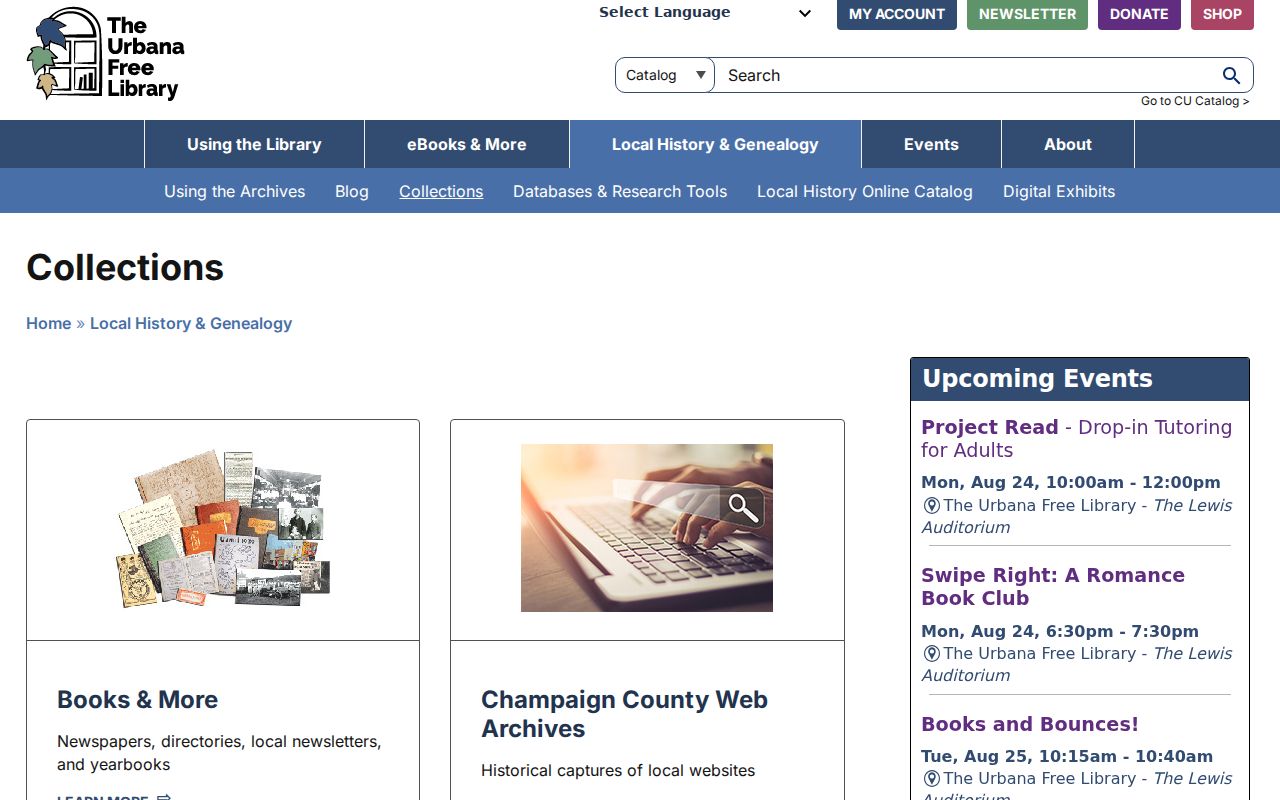
The collection joins printed volumes to maps, newspapers, photographs, oral histories, and more than 300 special collections.
Confirm Urbana Directory Clues
A directory is a dated publication, not a census taken on one day. Pair its address with the closest federal census year, available under the National Archives 72-year rule. Then check newspapers and obituaries. Urbana-area newspapers from 1822 through 1931 are available free online through the county library route; later papers are on microfilm or a library computer due to copyright limits.
UIUC student and telephone directories add a distinct campus layer. Identified holdings begin in 1898-1917 and related series may show a name, college and year, local address or telephone, home address, faculty, or official number. A campus entry can identify a student or staff member without proving parcel ownership. A tax card can name an owner without naming a student or boarder. That contrast prevents a common identity mistake.
The CCHA catalog search accepts keywords and can narrow by field, collection, type, tags, exhibit, geographic address, and radius. If the catalog does not expose the desired item online, use the staff, appointment, and copy-request channels.
Trace Family Through Urbana Directories
Build a family trail from dated evidence. Start with the clearest spelling and one likely year. Keep business and residence addresses separate, and compare only nearby dates. A directory may capture a person between census years, while the census may add relatives and household structure absent from the printed line.
- Search the surname, given name, initials, and likely business page in one known volume.
- Copy the printed address and abbreviations, then inspect the volume key and street guide.
- Move to the nearest earlier and later available years, noting every address or trade change.
- Pair the directory dates with the closest released census and relevant newspaper years.
- Follow a disappearance through obituary, probate, marriage, cemetery, or archive sources without assuming death or departure.
Absence has several possible causes: the series may skip that year, the person may be unlisted, the book may cover another geographic slice, or the household may have moved. An obituary, probate file, later directory, or deed can help decide. For a modern address-keyed search, move to the Urbana street directory rather than stretching an old volume beyond its date.